The Spanish page HEMC was asking us to prepare a tea-based dessert this month. You already know I'm not a tea lover, at least not in drinking form. But it's never too late to find another method or presentation so that I can get to like this weed. I've been spotting recipes with matcha tea for a long time now in the blogosphere, where its qualities are praised everywhere. Really everywhere... So I decided for once to stop resisting it and join the matcha initiated gang...
Good matcha tea is incredibly expensive. Fortunately you don't need a lot of it to make a good dessert. So I proceeded to spend an obscene amount of money in a 100g bag of matcha tea... it's so hard being a foodie. In case you've never seen matcha, it's a powdered form of tea with a lovely green hue. You can infuse 1 or 2 teaspoons in a cup of very warm water, never boiling, then stir it thoroughly to break the lumps, till it's frothy. You don't need to filter it. The result is a suspiciously looking green suspension. The day my tea arrived I decided to be bold and give it a try. Unfortunately it didn't change my mind, not a bit. The infused tea looked a lot like slime from the bottom of a nearby pond. But I still had to try it in a dessert. Why do I always give tea another chance? Like if it was any old boyfriend...
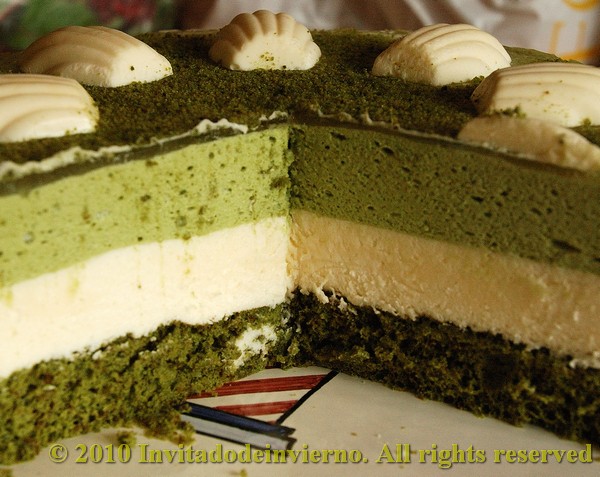
I opted for a light mousse tart. I would use a sponge layer, then a mascarpone mousse layer and a second layer of matcha mousse. The concept and recipes come from this web and this web.
Matcha and mascarpone mousse tart
Matcha sponge from Nordljus:- 10g matcha tea
- 50g flour
- 2 egg yolks
- 2 egg whites
- 60g sugar
- Preheat the oven to 170ºC.
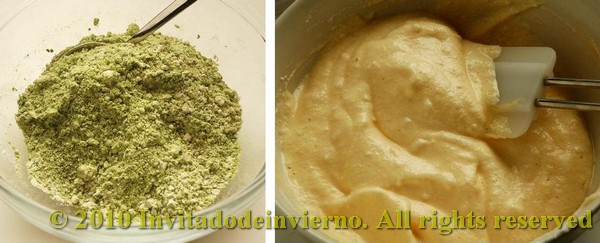
- Weigh the flour and the tea, mix, sift and set aside.
- Mix the yolks with half the sugar and cream them till pale.
- Mix the whites with the rest of the sugar and whip them to a meringue.
- Delicately mix the yolks and whites. Once homogenized, add the flour and tea mixture, little by little and mixing gently.
- Pour the mixture on a removable ring mold (I put parchment paper on the base to prevent it from sticking to the bottom). Bake for 12 minutes or until done. With a 20cm mold the sponge is 2.5-3cm tall. When done, tip it out of the mold carefully and let cool on a wire rack.
Mascarpone mousse adapted from Eddy Van Damme:- 3 gelatine sheets
- 180g whipping cream
- 4 egg yolks
- 60g water
- 90g sugar
- 250g mascarpone cheese
- First place the gelatine sheets in a bowl filled with cold water.
- I make my custard in my Thermomix 21: put the egg yolks in the mixer with the water and sugar, fit the butterfly on place and mix at speed 1 1/2, around 8 minutes at 80ºC. I've got a roast-beef thermometer I use to check that the temperature has really reached 80ºC, as time can vary depending on the eggs size and fridge temperature. If you don't have a Thermomix, make the custard on a bain-marie, in a double boiler or in a bowl over boiling water, till the mixture reaches the right temperature. When done, rinse the gelatine sheets and add them to the bowl. Stir to dissolve and let cool.
- Whip the cream to soft peaks. According to the recipe you should never whip it to hard peaks.
- When the custard reaches ambient temperature, mix it with the mascarpone cheese. Mix it with a hand-mixer if necessary, to break the mascarpone lumps. Then add the whipped cream and mix gently.
Matcha tea mousse, adapted from Nordljus- 3 gelatine sheets
- 100g milk
- 10g matcha tea
- 1 egg yolk
- 1 egg white
- 40g sugar
- 100ml whipping cream
- Put the gelatine sheets in a bowl with cold water.
- Pour the milk in a pot, add the tea, stir to break the lumps and heat it, but do not bring it to a boil.
- Cream the egg yolk with half the sugar till pale. Then add the milk-tea mixture and heat the mixture to 85ºC to make a thin custard. Better measure the temperature, like in the previous mousse. Add the rinsed gelatine sheets to the warm custard, stir to dissolve and let cool.
- Whip the cream to soft peaks like in the mascarpone mousse, set aside.
- Then whip the egg white and the rest of the sugar to a meringe.
- When the custard is cold, mix the cream gently. Then mix the meringue carefully, not to deflate it.
To lay out the tart
This needs some previous planning. Once the sponge is ready and cold, I freezed it to cut it. The top surface was somewhat domed, as any decent sponge surface should be. Therefore it needs to be cut to a flatter surface. I thought it would be easier on a frozen sponge.
Once the sponge is ready, put it into a mold that fits snugly around it or use an adjustable cake ring like me. Fit the ring snugly around the sponge, laid on a shallow mold or dish, and pour the mascarpone mousse when it's ready. If you use a removable ring mold, butter and sugar the sides thoroughly and take this into account: you must bake the sponge in a mold that's slightly larger than the one you'll be using for the whole tart, as the sponge shrinks in diameter upon cooling. If you'd bake the sponge in the same mold you'd use for the tart, the mousse would cover the sides of the sponge and you wouldn't see it from the side in the final result. If you use a slightly larger mold, just trim the sponge to the final size. I hope I've made myself understandable...
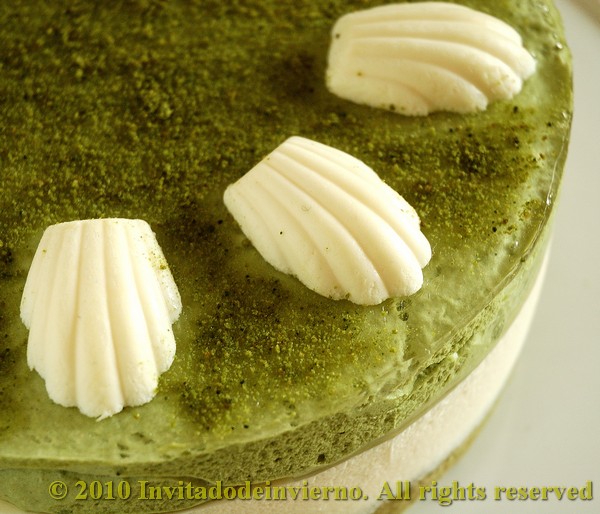
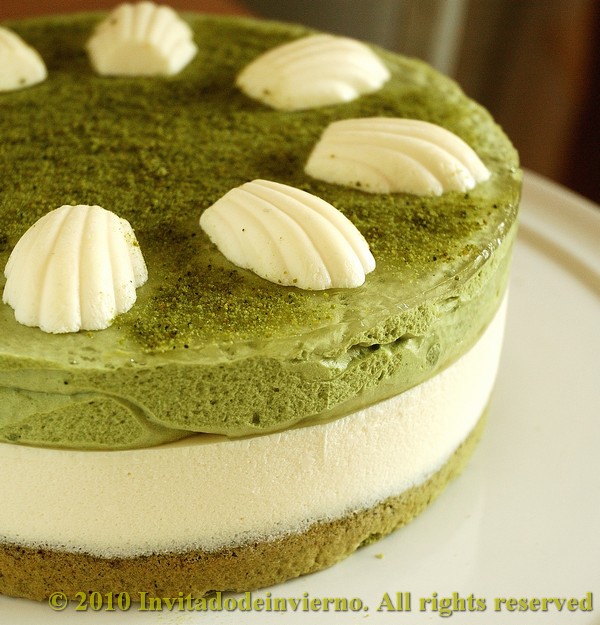
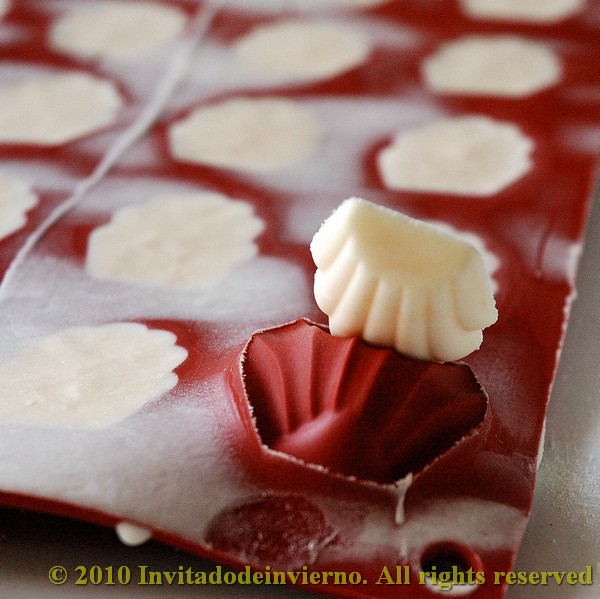
Regarding the mascarpone mousse, the amount is somewhat larger than you need for a double mousse layer tart. So I used the surplus to fill these little shell molds for bonbons. Then you freeze the little shells to be able to unmold them easily. If you don't have this kind of mold, you can use fancy ice cube trays. Once the mousse is poured on the sponge, you have to wait for it to set before laying the second mousse layer. I put it in the fridge while making the tea mousse. By the time you're done with the tea mousse, the cheese mousse will be set enough. Take the tart out of the freezer and pour the tea mousse. My remark on this: the difference between both mousses is that the tea mousse includes meringue, which the mascarpone's hasn't. I didn't notice much difference between them regarding consistency and creaminess but the tea mousse was a lot more difficult to handle in order to smooth the surface, for example. Although the original recipe doesn't mention it, I believe the meringue has to be whipped only to soft peaks for the mousse to softly "flow" upon layering. The cheese mousse flowed perfectly, filling all the surface irregularities of the sponge and yielding a beautifully homogeneous surface, on top and sides. However the tea mousse would not "flow" and I had to use a spatula to smooth it. In spite of that, the surface was quite uneven and the sides where not properly filled. Next time I'll make it right!
Once the tea mousse is laid, return the tart to the freezer so that you can easily remove the ring or mold. I made the tart in advance and left it in the fridge overnight. You've got to take it out of the fridge at least 2 hours in advance. To improve the horrible surface, I said to myself: don't worry, just pipe a thin gelatine layer on top for a shiny smooth surface. And so I did, but then I returned the damn thing to the freezer... big mistake. For those of you who, like me, thought you could set the gelatine by freezing it, you're wrong. The gelatine crystallizes into an uneven and matt surface, just the opposite of what I intended. Ignorant. But I'm a woman-of-infinite-resource-and-sagacity. I had collected the sponge trimmings, which by now were completely dry and crumbly. So I thought I'd made them into a powder and sprinkle the surface to hide the horrible gelatine. Then I laid the cute little shells and sprinkled the green powder... I've made uglier tarts. My kids said I should have placed a mini SpongeBob in the middle... To cut a long story short, the green layer was very uneven on the tart side and the gelatine permeated at some points, you can see it in the photos. But practice makes perfect. And I've got to publish a failure every now and then. Not everything in my life is sheer success.
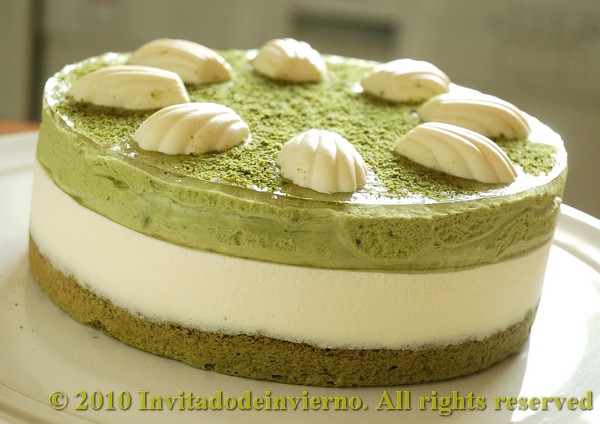
The tasting result: I must admit in this case the tea flavor was delicious. The tart was very soft, light and with a subtle tea flavor that didn't overwhelmed you. The same for the mascarpone flavor, which by the way makes a great combination with the tea. A real keeper, I will repeat it no doubt, as all the guests loved it. In spite of all its flaws.
Eager to know more?