Related Posts Widget for Blogs by LinkWithin
Showing posts with label Peter Reinhart. Show all posts

San Francisco sourdough bread

>> Wednesday, April 7, 2010

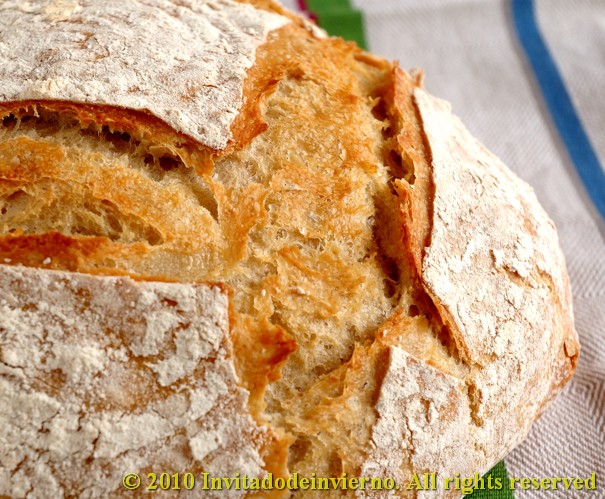
San Francisco sourdough 1

Those of you out there who are among the followers of the Holy Sourdough know that the only rite of passage that allows you to qualify for a gold-plated bread-scoring tool is to make a San Francisco sourdough bread... I admit I had always wondered, somewhat skeptically, if San Francisco yeastie beasties would be much different from the ones in the Spanish plateau (the rain in Spain doesn't stay mainly in the plain...). But I've been lucky enough to get some of these bugs from my generous friend Bea... so that I could check myself. I haven't reached a definite verdict though.


Here's what baker Peter Reinhart says about the bugs and San Francisco sourdough:

(...) a wild strain of yeast called Saccharomyces exiguus is used to make sourdough bread, as opposed to S. cerevisiae used in regular breads. But the complex sour flavor is not created by the wild yeast. Other bacterian organisms, specifically lactobacillus and acetobacillus, create lactic and acetic acids as they feed off the enzime-released sugar in the dough, and these are responsible for the sour flavor. San Francisco sourdough bread, for example, has a particular type of local bacteria called Lactobacillus sanfrancisco (...) that gives this bread a different quality, more sour with a thicker crust, than any other wild-yeast bread made in other parts of the world.
If Reinhart says so... The peculiar flavor that this sourdough imparts comes from one of those bacterias, from the lactobacillus type. Well, I only know that I have baked two breads with this sourdough so far and either I've finally learnt to bake decent bread or this sourdough is really special. Both breads were wonderful, with a delicious flavor that caused them to disappear in no time. The recipe I used is nothing special:

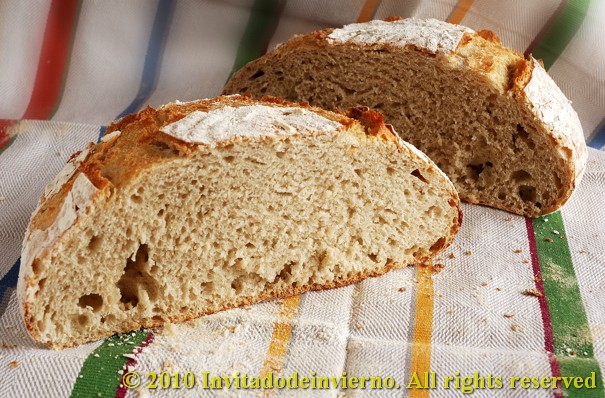
San Francisco sourdough 2
  • 200g San Francisco sourdough, fed with spelt for several days (baker's percentage: 100%)
  • 300g water
  • 500g white bread flour (I had to add 50g more)
  • 2 tsp salt
  1. Mix all the ingredients and knead by hand or in a stand mixer, till the gluten is well developed. Make a ball and put it inside an oiled bowl, cover with a plastic shower cap and put in the fridge. Leave to proof overnight.
  2. Take the dough out of the fridge the next morning and leave it to temper on the counter and to further proof. It must double in bulk. It will take at least 2 hours.
  3. When doubled in bulk, tip the dough on a well floured counter and shape in whatever shape you like. Then put the formed loaf on a floured cloth, a bannetone or a large bowl, depending on the bread shape, and leave to rise again.
  4. I usually bake my loafs in a Dutch oven. Preheat the oven to 250ºC (that's the maximum reached by my oven) with the Dutch oven inside. When the loaf is doubled, take the Dutch oven out on the counter and slide the bread into it. Score it, cover with the lid and put it back into the oven. This bread hardly took 30 minutes to bake. Check the inner temperature, it should be at least 92ºC (large tears rolled down my cheeks when I opened the Dutch oven to find such a stunning bread... I had never baked such a beautiful bread before... so well risen, with such an appealing color...).
  5. Then let the loaf cool on a wire rack and... devour it. I can't express how delicious it was with butter...
And being that I am a studious little girl, I'm more than willing to try this sourdough again just to check if its flavor and aroma are really special or not... as many times as needed. Sorry, I must be going, I've got some baking to do. Bye.

San Francisco sourdough 3

I almost forgot! I'm sending this bread to Susan's Yeastspotting... don't forget to check it tomorrow for a weekly showcase of breads!

Eager to know more?

Spelt pain a l'ancienne

>> Wednesday, November 25, 2009

Spelt pain a l'ancienne
This is Peter Reinhart's recipe for pain a l'ancienne, from his book The Bread Baker's Apprentice. It's a very easy bread because it hardly needs any kneading and it only ferments once. The fermentation is retarded by mixing all the dry ingredients with ice-cold water. This time I used spelt for the bread, as I always do lately. The dough is tremendously soft, like that of ciabatta, so that's what I made: small beautiful ciabattas. Take into account that you have to start this the day before, as the dough needs to rest overnight in the fridge.


I'm especially fond of spelt. This is what La Espelta y la Sal, Spanish spelt producers located in Sigüenza say about it:

Spelt is a primitive wheat variety, whose properties are well known and appreciated since the days of old. In Europe, it is mainly cultivated in Germany, France, Switzerland, Austria and also in some areas of Spain, (...) Spelt is rich in magnesium, phosphorus, iron and vitamins A, B and C. By consuming it on a daily basis the levels of cholesterol and triglycerides can be lowered, and it also controls metabolism, especially the sugar metabolism. It carries a higher amount of essential aminoacids than normal soft wheat and it also has a higher vitamin and mineral content. It is worth noting the presence of silicic acid, which enhances brain activity and assists in skin and hair care. Spelt has also a high gluten content, making it therefore very convenient for baking. In Central Europe it is considered to be a gourmet's grain; in France it is known as the caviar among cereals. Its flavor vaguely reminds of walnuts.

Well, this is the producer's word and I guess they have to be positive about spelt. But anyway, I've already read about it in several places where it is said that spelt is indeed more nutritious than white wheat, and that it's been abandoned because of the yield, which is higher for white wheat, and disregarding quality. In any case, the essential thing for me is that the flour is organic and that it retains the germ, that part of the grain that keeps most of the nutrients and beneficial substances. "Industrial" flour lacks the germ, because the milling process eliminates it; it's like if you ate eggs without the yolk. And this lack of nutrients is compensated by adding vitamins, among other additives. If you want to know more about this, check In defense of food, by Michael Pollan.

Spelt pain a l'ancienne (adapted from P. Reinhart)
  • 600g spelt flour
  • 2 tsp salt
  • 450g ice-cold water (put some ice cubes in a bowl and weigh them, then add water up to 450g)
  • 5g dry baker's yeast or 15g fresh yeast

Leave the ice-cubes to melt. Weigh the flour, put it in a large bowl, crumb the yeast on top of the flour and mix. Add the salt and then the water. Mix thoroughly and knead 5 minutes by machine or 8 by hand. There's no need for the gluten to develop. Then oil a large bowl, put the dough ball in, cover with plastic and leave in the fridge overnight.

Spelt pain a l'ancienne
The next day take the dough out of the fridge. It will be expanded, but not doubled. Leave to temper at room temperature and let it double, as long as needed. When the dough has doubled in bulk, tip it on a very well floured counter as it is a very soft dough. Turn on the oven in the meantime, up to 290 ºC according to Reinhart, but my oven is not that good... Stretch the dough forming a rectangle and taking care not to degas it too much. Prepare 2 sheets of parchment paper on 2 baking trays. Thoroughly sprinkle them with semolina.

Then cut strips of the dough, around 10-8 centimeters wide, depending on the kind of bread you want to make. You can leave them as thin strips for baguettes or fold them in 3 as ciabattas, like I did. Transfer the strips to the parchment paper. Sprinkle the surface of the breads with flour for that super-rustic-wrinkled-ciabatta look. When the oven is at full heat, transfer the paper with the breads on onto the baking stone if you have one. If you don't, you can bake the bread straight on the baking sheets, no problem. Spray water on the oven walls and close the oven door immediately. Repeat this 3 times at 30 seconds intervals. Then lower the temperature to 250 ºC... I wish I could. My oven temperature was not that high. My oven had one of those days... full of personality. Bake for half an hour or until the bread has an internal temperature of 95 ºC (if you have a roast-beef thermometer).

Spelt pain a l'ancienne
The bread turned out delicious. Spelt has less gluten than common wheat and the crumb doesn't show the same picturesque holes. But I like spelt a lot. I was born that way. I never get a super crispy crust in my oven, unless I make sourdough bread inside my Dutch oven. I guess too low a temperature is the reason.

Spelt pain a l'ancienne
I encourage you to try this bread. It requires hardly any serious effort and the result is excellent. The cold water and the fridge do most of the job. Perfect for beginner bakers.

I'm sending this bread to Susan for YeastSpotting.

Eager to know more?

Middle-class brioche

>> Sunday, October 18, 2009


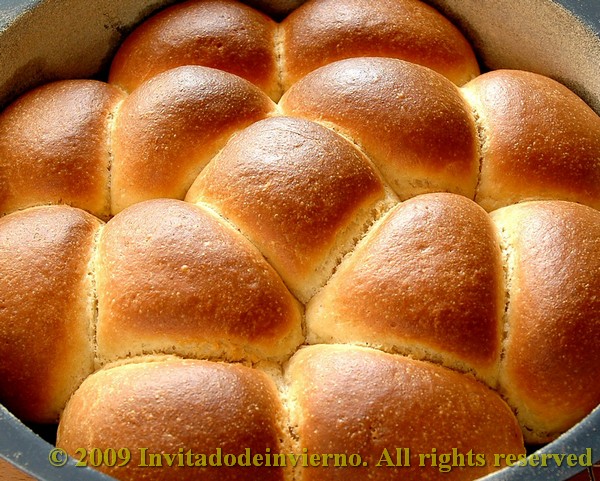
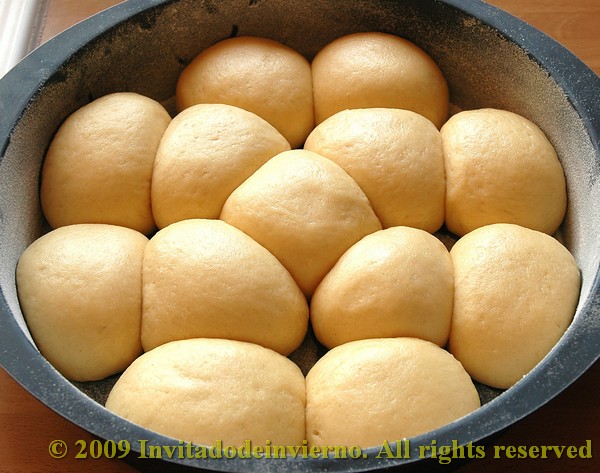
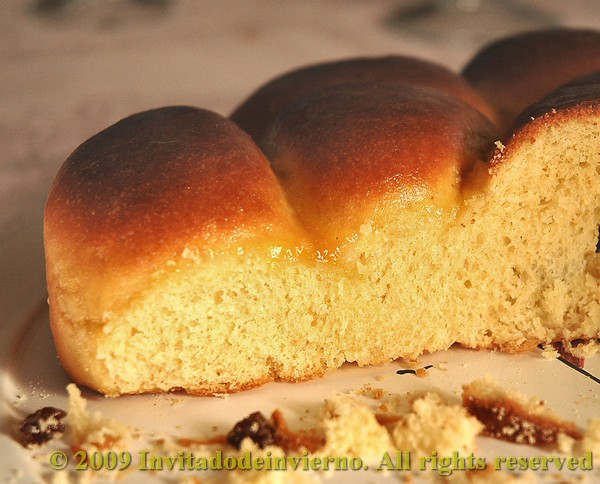
I haven't made brioche too often and I don't seem to get hold of it. When I cook a recipe some times I'm lucky and it turns out right the first time and some others, like this one, I have to go through a trial-and-error process. The previous brioche I had baked was delicious, very fluffy, but somewhat overfermented. It had to wait for its turn to get into the oven. It was in a queue behind a roast and a bread... I told you, I need a second oven. This brioche suffered just the opposite: I didn't allow for a complete proofing. But it turned out so beautiful, my little brioche, that I can't resist but posting it.


The middle-class thing comes from the brioche categories included in Mr. Peter Reinhart's book The Bread Baker's Apprentice. The rich-man's brioche is made with a butter weight approximately the same as the weight in flour, the poor-man's brioche is made with a butter weight which is a fourth of the flour weight and the middle-class brioche... well, it's something in between. Nonetheless in the end I took the recipe from the book 100 Great Breads, by British baker Paul Hollywood. I used this one instead of Reinhart's because the process is shorter (yes, I'm always short of time). Reinhart prepares a sponge, leaves it to ferment and then he mixes the sponge with the rest of the ingredients. The complete dough is then left to proof overnight in the fridge. Mr. Hollywood skips the sponge without any remorse.

Middle-class brioche from 100 Great Breads

  • 375 g strong white flour
  • 40 g sugar
  • 15 g fresh baker's yeast
  • 1 pinch salt
  • 75 ml milk
  • 3 medium eggs
  • 185 g butter at ambiente temperature
Mix all the ingredients except the butter in a mixer or by hand. Then knead for 5 minutes by machine or 8 minutes by hand, till the dough is smooth. Add the diced butter and knead again for 5 minutes by machine or 10 minutes by hand. Put the dough into a bowl, cover tighly and leave in the fridge overnight.


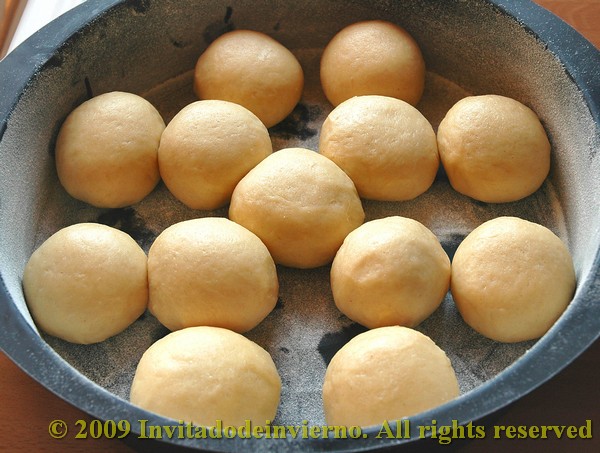
Take the dough out of the fridge the next day and make 60 g balls while cold. I could make 13 little balls and there was a bigger ball leftover which I used for a brioche a tête in a muffin mold. My eldest son ate this one, straight from the oven. I'm sure he burnt his mouth, but he won't admit it. Then shape the balls and put them into the mold, with seam face under, leaving quite some room among them as they expand quite a lot. Cover the formed brioche and leave to proof at least one and a half hour, till more than double in size. I should have left it a bit longer, but I had to bake it for me to take it to my parents' house, to be served for dessert at some family meal... I lead a hard life. In the meantime preheat the oven to 200 ºC. Once the oven is a the right temperature, bake it for 20 minutes. It can be brushed with egg yolk prior to baking, but I preferred to make an apricot jam glaze (it seems I never find the right ocassion to use the frozen egg whites) for glazing when cooled. I used two large spoonfuls of apricot jam, heated and strained, with a sheet of gelatin. Brush the cooled brioche with the glaze, leave it to drip and you're done.


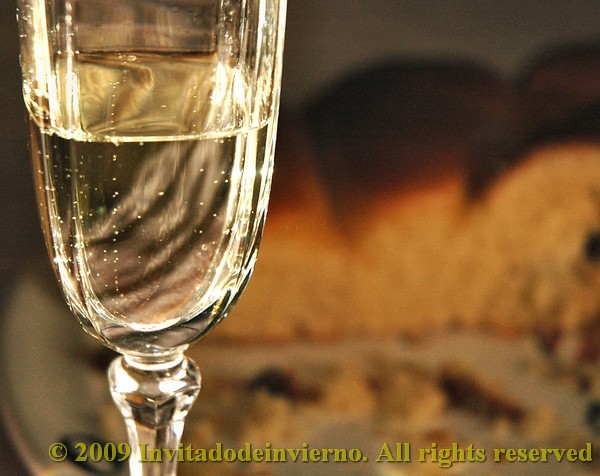
And... eat it with a tall glass of cava... or two... or three... I'm sure it's perfect for killing the H1N1 virus. You can use the leftover as toast for breakfast... nothing's to be wasted, we're in a crisis!

By the way, this bread goes to Susan/Wild Yeast for her lovely YeastSpotting.


Eager to know more?

Peter Reinhart's 100% rye sourdough bread

>> Friday, September 4, 2009


First of all, Mr. Reinhart, are you cheating on us? Because in spite of the name, this bread includes a small ratio of wheat flour and, though included in the sourdough section of The bread baker's apprentice, it carries normal bread yeast too. Reinhart, you should be punished... :-).


This is a 2-3-day bread, since it requires a sponge that needs to sleep in the fridge overnight and the second fermentation is retarded in the fridge too. I made the bread in two days because my kitchen was very warm and the second fermentation was really speedy... so much that the bread overfermented while waiting for my bloody oven to get the right temperature. Pathetic. When I'm rich I will revamp my kitchen and install a professional 90 cm oven that reaches at least 1000 ºC in the shade, a volcano of an oven.

But you're wondering, I know... if the bread came out wrong, why is she posting it? Because you can learn from my errors, be patient. And I can do it better next time if I record all my mistakes now. And because in spite of everything the taste was delicious.


100% rye sourdough bread from "The bread baker's apprentice"

Sponge

  • 100 g sourdough 50% hydration (Reinhart's is made out of wheat, I had rye's and that's what I used. It worked out fine)
  • 130 g bread flour
  • Vegetable oil
Soaker
  • 55 g whole rye flour, coarsely ground (I didn't have coarsely ground rye flour, I used 20 g mixed grain and the rest of flour)
  • 120 ml water at ambient temperature (funny, ambient temperature is not the same in August as in January, not very accurate hint...)
Final dough
  • Sponge
  • Soaker
  • 380 g white rye flour
  • 1 1/2 tsp salt
  • 2 tsp dried bread yeast
  • 175-240 ml warm water (32-38 ºC)
  • 2 tsp caraway seeds (I preferred not to. Chicken.)
Prepare the sponge. Mix all the ingredients and add some water if needed to make a ball. The ball must be firm, not very sticky. Just mix, don't knead it very much. Oil a bowl, put the ball in, turn it for all its surface to oil, cover with some plastic film and leave it to ferment until doubled. Once fermented, leave it in the fridge overnight.

Prepare the soaker by mixing the flour, seeds and water. Put some plastic film on it and leave it overnight at room temperature. According to Reinhart, the soaker helps condition the grain and allows for the enzimatic activity to develop, so that more sugar in the flour is released.

Now, did you already get up and do you have your soaker and sponge at hand and ready? Reinhart recommends to cut the sponge in a few pieces and leave it at room temperature for a while for it to temper more easily. I didn't do it because of the heat in my kitchen and because I'm an unruly girl. Mix everything (adjust the amount of water according to the dough consistency) and knead by hand for 4 or 5 minutes, a bit shorter if you use a mixer. Put the dough in an oiled bowl, cover with plastic film and let it double its volume. Mine took only two hours and a half.


Once the dough has doubled, tip it on the counter and shape two bâtards, trying not to degass too much. I preferred to put all the dough in a loaf pan. So I left it to double and that was my main mistake... I went away to another room and forgot about it. I thought it would take at least one hour more and it didn't. At this point you can also put the wrapped bread into the fridge and leave it to proof overnight. The thing is that when I went to have a look at the bread it was nearly doubled in size and then I immediately turned on the oven and had to wait for it to reach the righ temperature. At some point I thought I couldn't wait any longer because I didn't have the guts to see my bread sinking to the bottom of the pan and then I put it in the oven when it had barely reached 200 ºC (Reinhart advises to start the baking at 260 ºC, spray water in the oven several times after putting the bread in and then go down to 230 ºC). In short, I tried to do my best. As can be seen in the pictures, the bread had no oven spring at all. It even sunk a little bit because of the overfermentation, and the crust was a bit too hard because of the longer baking at a low temperature. It took 40 minutes to bake, when the advised time is less than 30.

But... in spite of so many blunders... the bread was scrumptious! The consistency is similar to those creamy and dark German breads and the taste is delicious. I strongly recommend it for breakfast, with butter and smoked salmon, with cheese, with scrambled eggs...

By the way, this bread goes to Susan's Wild Yeast, as a rentree after this very long summer...

Eager to know more?

Sourdough bread with rye and spelt

>> Tuesday, April 14, 2009

I'm in the mood for baking bread. I've taken up again on sourdough and feel like practising different techniques. I've got the impression that my stand-mixer doesn't bring out the best in the dough. I decided to hand-knead this bread, French method here. As I always end up with absurd amounts of sourdough because I refuse to throw away a single bit, the recipe I used is as follows:


Sourdough bread with rye and spelt

  • 500 g (18oz) whole spelt sourdough, 50% hydration
  • 200 g (7oz) refined spelt flour
  • 150 g (5.3oz) semi-whole rye flour
  • 150 g (5.3oz) water
  • 1 tablespoon wheat germ
  • 2 teaspoons Himalayan salt (or any other good salt)
  • 1/2 teaspoon gluten
  • Splash of maple syrup (optional)
All these flours are organic and come from Rincón del Segura. I added the maple syrup on an impulse, I'm hooked lately, it's deliciousssss.

To add gluten... well, if rye and spelt flours have less gluten than white wheat, why not supplement with some added gluten? I've found some references on adding gluten to rye breads, but I'm not sure of the ratio. I've got to make some tests.

Back to my point. Mix all the ingredients (I did use my stand mixer for this), except the salt. Leave it to rest for 10 minutes (autolysis) and then add the salt. Integrate the salt and put the dough on the counter. Be rough on the dough "a la française" at least during 10 minutes (the guy in the video talks about beating it 600 times), shape it into a ball, put it into an oiled bowl, cover with plastic and leave it in the fridge overnight.

Next morning take the bowl out of the fridge and let it warm up to ambient temperature. Rye and spelt dough doesn't rise as much as white wheat dough, at least mine didn't, so don't expect it to double in bulk. Shape the dough as you like, I made bâtards and heat up your oven to 250 ºC (480ºF). I usually leave the shaped dough to proof on an oven tray with a floured cloth and inside a plastic bag. This is a recommendation by Peter Reinhart. After one hour more or less I put the bread in the oven with my mock wood peel on my mock oven stone... and then sprayed it three times with water during the first 5 minutes. For a super rustic look I had sprayed the bâtons with water and sprinkled some rolled cereal just before putting them in the oven. They baked for half an hour, more or less, but I always check for doneness with a thermometer. According to Peter Reinhart the inner temperature must be somewhere around 95 ºC (200ºF) when properly baked, at least for white bread. And then out to cool down on a grid.

In the picture it can be seen that in spite of the dense crumb characteristic of rye and whole breads, my bread had some big holes in it. I don't really know where they came from. The bread had a delicious flavour. It was a great success in some family meal and there wasn't a single crumb left.

Eager to know more?

Followers

About This Blog

Lorem Ipsum

  © Blogger templates Palm by Ourblogtemplates.com 2008

Back to TOP